
From Ma’s Desk:
A hearty welcome to the third issue of Conversations, the annual newsletter of Convergence. The first newsletter came out in September 2022, a month after ma was no more. The second issue came out in July 2023. Last year in July, we published a collection of ma’s articles titled “Collection of Articles on Modern Sanskrit : Volume 1”. This year once again, we are happy to bring you Conversations (the third issue).
Like the last issue (2nd issue of July 2023), this issue is entirely in an online format, mainly because that’s how it is acceptable to a lot of readers nowadays and also because of environmental reasons (saving paper and trees).
On the top of the page, you will find tabs like Archive (which contains links to the last two issues of Conversations), Summary (which contains the summary of activities of Convergence for the past couple of years), Students (which lists the students of Convergence for the last couple of sessions in our various courses), and Convergence (which will take you to the main homepage of Convergence), Photo Gallery (which displays some of my clicks) other than links to Articles, Poems, and Paintings.
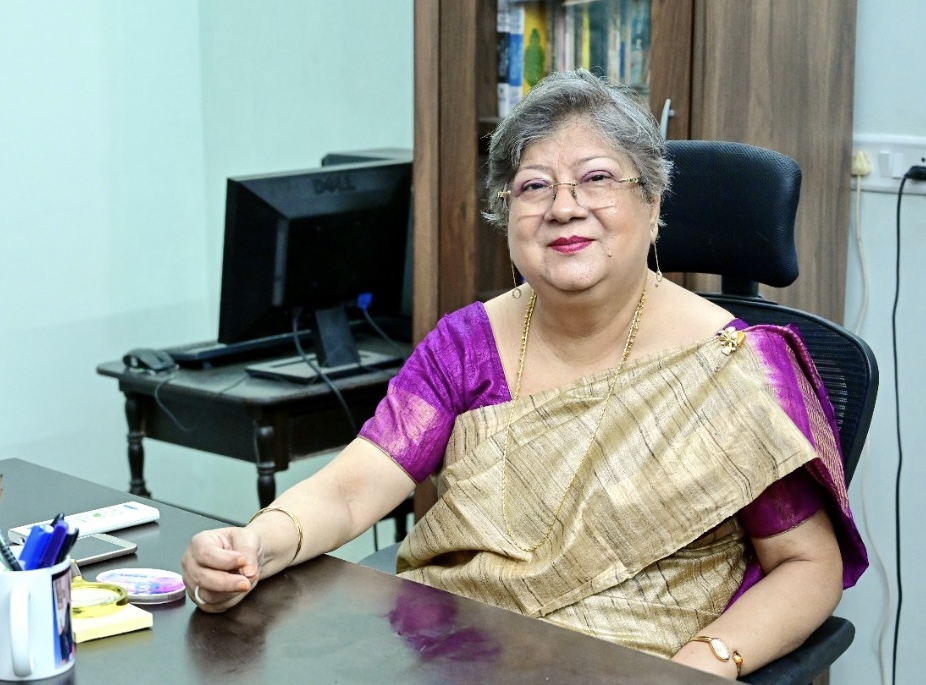
On top, this time, is a painting of ma by painter Tathagata Choudhuri, which is water colour on canvas. When I had reached out to him for some of his paintings for Conversations, he voluntarily wanted to paint a portrait of ma – and refused to accept any kind of monetary remuneration for his efforts. I am ever so grateful to him, not only for the amazing portrait of ma, but also his kindness – I am touched and honoured to know an artist par excellence with such a magnanimous heart.
Then there are some articles by ma – not all of which are academic. The one on Durga (and Navaratri and Vijayadasami, with some overlaps amongst them) was originally prepared for an online program of elders group that she was a member of. We found some of her original writings, but not all, so I actually heard her narration and filled in the gaps.
The one on “Ancient India in Tagore’s Writings” (রবীন্দ্রনাথের রচনাতে প্রাচীন ভারত, রবীন্দ্ররচনাসু প্রাচীনং ভারতম্) was actually a program on All India Radio held on 7th May 1995, exactly about thirty years back.
The ones on Modern Sanskrit and শ্রীজীবসম্ভবসাহিত্যালোকম্ have been published as books later on and these are just abridged versions or excerpts at best. Modern Sanskrit of course, was her forte and she has several other books on the subject. And has monographs on other great Sanskrit scholars as well.
As Debdas Mandal lovingly details in his article (আধুনিক সংস্কৃত সাহিত্য চর্চার পথিকৃৎ: ড. ঋতা চট্টোপাধ্যায়), ma had worked tirelessly to gather all the information in her books – from visiting Pandits/scholars, talking to their kins, retrieving almost lost manuscripts from libraries, digging through old papers and books at their ancestral homes and so on. The result was books that posterity could cherish and work on. Not only did she work continuously to bring such scholars into limelight, her efforts actually brought to the fore what is anachronistically called “Modern Sanskrit”. She championed through her work that Sanskrit wasn’t a dead language and there were and are still numerous compositions in modern times in Sanskrit, that are modern in both technique and content.
Similarly, Arpita Sinha Choudhury’s article (“কান্তাসম্মিততয়োপদেশযুজে” : শ্রদ্ধায়-স্মরণে আমার ম্যাম অধ্যাপিকা ড.ঋতা চট্টোপাধ্যায়) dwells on more personal aspects of ma’s loving and caring personality – her support, love and understanding for her students. Arpita teaches Sanskrit at Convergence and was ma’s student at Jadavpur University a couple of decades back. Her article is a very moving portrayal of the way she has perceived ma over various interactions she has had with her.
The other contributions form a varied background, as do the contributors this time – there are contributors who have retired and love writing out of passion (like Parmesh Goswami and Rupak Biswas) to those who are in the midst of extremely busy exam schedule like Esha (and everyone in between), from professional painters to amateur dabblers (and everyone in between).
So Conversations this time, truly upholds the spirit of Convergence in many aspects, and Conversations in true sense – conversations with the world around us, conversations with our own self, conversations with our past and heritage, conversations with our future (the scary future at times), conversations in words, and through paints and brushes and pens and pencils.
I have been extremely fortunate to receive very interesting, erudite and thought-provoking articles for this issue of Conversations. Paramesh Goswami, renowned writer and scholar, has written about the possible circumstantial inspiration for one of Tagore’s songs in যা হারিয়ে যায় তা আগলে ব’সে রইব কত আর?, and in চৈতন্য অন্তর্ধান he has pen portrayed the life and times of Sri Chaitanya. The latter reads like a mystery thriller – he brings out the political intrigue and societal maladies of the times and the way mystery shrouds the disappearance of Mahaprabhu.
Swati-di (Swati Parrack) has regularly contributed to Conversations, right from its first issue. This time she has written an extremely interesting article on total solar eclipse titled “২০২৪-এর পূর্ণগ্রাস সূর্য গ্রহণ”.
Aparna Singh’s piece titled “To write or not to write” is a philosophical one that vividly and sympathetically journeys through the inner torments and dilemmas inside a writer’s mind.
Moumita, who is our dedicated German language teacher, has written a very touching piece on Murshidabad titled “The Cultural Kaleidoscope of Murshidabad – it talks about its various traditions and cultural practices that are on the verge of getting extinct. It is extremely well researched and puts forward her angst about how we lose sight of our very rich and varied cultural heritage.
Shabana and Tanushree, who are our English language teachers and been with us for quite some time, have contributed beautiful English poems – Shabana’s is titled “Old Dreams” and Tanushree’ s “Presences”. One gets hooked from the very first lines of Presences:
“I can’t ever know the sky
In the way of the magpie.”
And leaves you with lingering questions, “Do old dreams water old past?
Or do they outlast?” (Old Dreams)
Rupak Biswas’s story (স্বপ্ন) is a telling tale of the dwindling value of books in our lives.
Riya Mondal is a student in two of our Convergence courses (German and Sanskrit) and has contributed a very nice Bengali poem titled “বিষাদ”.
Last but not the least, Esha Ganguly, a bright young lady, who is preparing for her CA exams and writes extremely well, has still spared some time to contribute for Conversations. Her very thought-provoking article, extremely deep and matured (especially when compared to her age) dwells on the irony of today’s advancement. Titled “Why do half burnt candles fall?”, the article talks of man’s unbridled and mindless pursuit of technological advancement, often at the cost of everything else. “Must be nice knowing he can chase spaces, change geography, mutilate history, freeze time and engineer existence as per the mould that suits him.” Indeed!
I have written a piece titled “Visiting Vienna: A Beautiful Walk Down Memory Lane”. I had visited Vienna when I was about nine years old, some thirty five years back, accompanying ma on a “World Sanskrit Conference”. It was the first trip abroad for both ma and me. We visited Vienna a couple of months back again, this time for an academic talk of mine, and had my daughter with me. Maybe some decades hence, my daughter will visit Vienna with her daughter. So I dug up the old photos and wrote whatever I remembered from our earlier trip.
Far from the madding crowds ignoble strife, nestled in the world of innocence, are some paintings by children that bring relief to our eyes and frazzled nerves. And of course, more of Tathagata Choudhuri’s artistic excellence at display.
I will be very happy if you can spare some time to read all the articles and poems and email your feedback/comments to soumyanetra.convergence@gmail.com. Would love to have them (and share them – it does matter for creative artists to get appreciation and encouragement for their labour and passion).
As always, Convergence would not have been possible without the stoic and unwavering support of some of its members right from its inception – from the time when ma was there, and now when I am trying to carry forward its mission.
Convergence also would not have the German courses without dedication of teachers like Swati Parrack and Moumita Ghosh, who have been teaching the online German courses from the very beginning. Both of them go out of their ways and devote time to teaching their courses. And in fact, there are not only four levels, but also a fifth level that Moumita will offer to very advanced students. She has called it “Conversational Intensive German”. All the best with that Moumita! They are like solid pillars in the Convergence edifice and I am greatly honoured to have them in our Convergence family.
Equally sturdy pillars are Shabana and Tanushree who are PhD scholars in English and teach the various English levels in Convergence. And my gratitude knows no bounds for Aparna Singh who has been much more than a friend in lending me all kind of psychological and emotional support that running Convergence requires, the least of which is putting me in touch with the English instructors, Shabana and Tanushree.
I am grateful to Arpita Sinha Chowdhury for always remembering ma so lovingly and respectfully and carrying forward the Sanskrit course at Convergence.
Debdas Mondal, who has been one of ma’s younger colleagues at Jadavpur University, has been an indispensable part of the organisation right from the beginning.
Sujit Maiti has also been a part of Convergence right from the beginning and helps in opening the library and types ma’s articles. He also helps coordinate the various online courses and announcements.
All my gratitude to our students in the various courses (in the past and the current courses) for enthusiastically participating in the online courses of Convergence making ma’s efforts of creating such an organisation, a huge success. My thanks also to scholars and students who visit the Convergence library frequently from near and far, making ma’s dreams of the library serving the student/research scholar community, come true. And of course, I am grateful to all those who have come forward to give online lectures at the Convergence platform.
Last but not the least, this online newsletter, homepage and all technical support is provided by Samit Basak of Bengal Computers who has very patiently paid attention to my innumerable requests, incorporating small changes in the presentation and the content of the newsletter as well as the homepage.
Kindly circulate links to this issue, and previous issues of Conversations, our homepage, our courses, our lectures etc. for wide dissemination of our work. Hope you will consider contributing to all future issues of Conversations.
I hope you will continue to be by my side with all your blessings, support and wishes, the way you have been beside Ma, in her journey heading Convergence.
Happy conversing!
Soumyanetra